
USDT Withdrawal Fee Comparison: TRC20 vs ERC20 vs BEP20
There is no permanently fixed answer to the question of USDT withdrawal fees, but under typical conditions, transfers through TRC20 and BEP20 usually cost less than ERC20 transfers. The right network depends on more than the fee. You must also consider whether the receiving platform supports it, how you plan to use the USDT, your arrival-time requirements, and the actual fee currently charged by the withdrawal platform.
For Hotcoin users, the most reliable approach is not to memorize a fixed rate but to check the available network, fee, and minimum withdrawal amount shown on the withdrawal page. Put simply, if the recipient supports TRC20, ERC20, and BEP20, you can compare their current fees. If the recipient supports only one of them, matching the network takes priority over choosing another chain to save on fees.
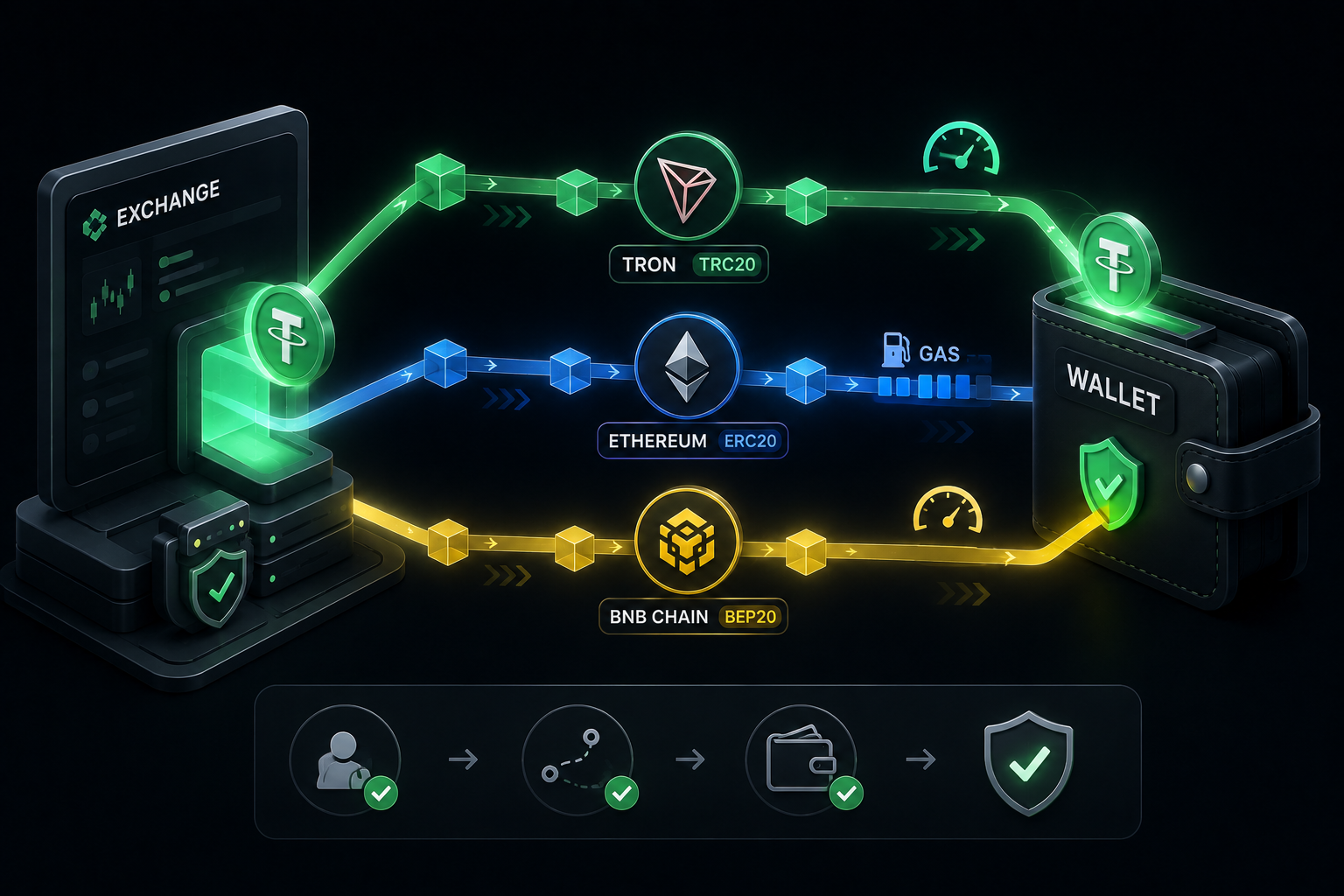
What Is the Difference Between TRC20, ERC20, and BEP20?
TRC20, ERC20, and BEP20 can all be used to issue and transfer USDT, but each corresponds to a different blockchain network. TRC20 runs on TRON, ERC20 on Ethereum, and BEP20 on BNB Smart Chain. They therefore differ in fees, ecosystem applications, address formats, and use cases.
A common misconception is that they represent three different types of USDT. In reality, choosing TRC20, ERC20, or BEP20 means choosing which blockchain network will carry the USDT, not choosing among three completely different stablecoins.
It is also important to distinguish a network fee from an exchange withdrawal fee. A blockchain has its own transaction costs, while the fee shown by a trading platform when you withdraw may be set separately according to platform rules, network costs, wallet operations, and risk controls.
How Are USDT Withdrawal Fees Calculated?
When you withdraw USDT from a trading platform, the most direct calculation is:
Amount received = Withdrawal amount − Withdrawal fee
For example, if you plan to withdraw 500 USDT and the withdrawal page shows a 1 USDT fee, the amount received under those displayed terms will be 499 USDT.
This is only a calculation example and does not represent Hotcoin's current rules.
To compare the cost of different withdrawal networks, you can also calculate the fee as a percentage of the withdrawal amount:
Fee percentage = Withdrawal fee ÷ Withdrawal amount × 100%
For example, a 1 USDT fee represents 1% of a 100 USDT withdrawal but only 0.1% of a 1,000 USDT withdrawal. A fixed fee therefore has a much greater practical effect on smaller withdrawals.
When comparing USDT withdrawal costs, do not ask only which network has the lowest fee. Also ask what percentage of your withdrawal the fee represents.
Which Has the Lowest Fee: TRC20, ERC20, or BEP20?
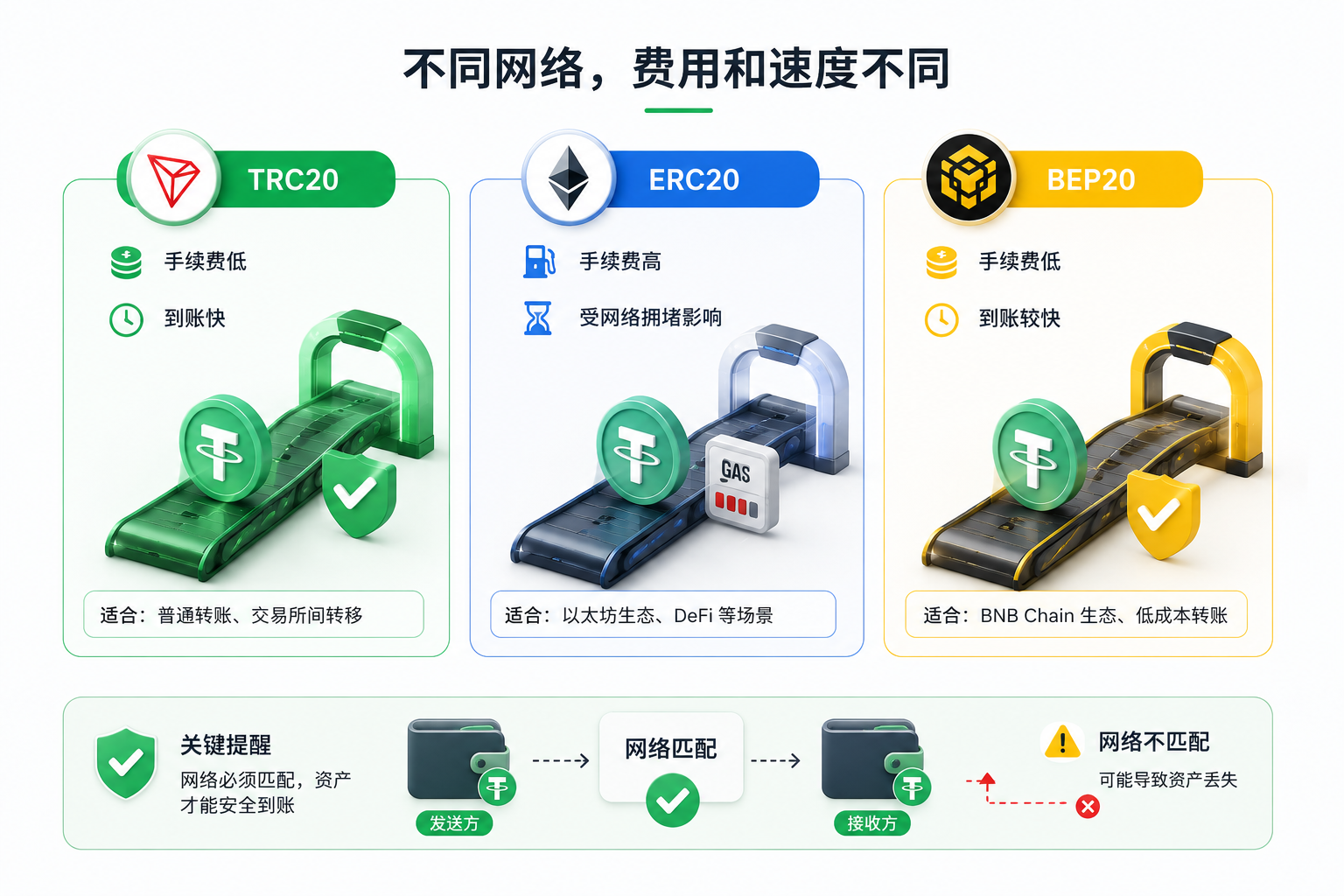
If you compare typical on-chain transfer costs alone, TRC20 and BEP20 are generally cheaper than ERC20. This does not mean that TRC20 or BEP20 will always be the cheapest. Exchange withdrawal fees can change, and different platforms may charge different withdrawal fees for the same network.
For most users, the practical method is to first confirm which networks the recipient supports and then check the actual fee shown on Hotcoin's current withdrawal page. If all three networks are supported, choose according to the current fee and what you plan to do next. If only one network is available, there is no reason to switch networks merely to save a few USDT.
You can think about the decision in this order:
What the recipient supports → Where you will use the funds next → The current fee → Your final network choice
Do not simply select the option that appears cheapest on the page.
Why Is TRC20 USDT Often Used for Low-Cost Transfers?
TRC20 USDT runs on the TRON network, which has relatively low network costs in many common transfer scenarios. It is therefore frequently used to move USDT between trading platforms. If your goal is simply to transfer USDT from one TRC20-compatible platform to another, TRC20 is often worth comparing first.
However, the advantage of TRC20 depends on recipient support. If the receiving platform offers only ERC20 deposits, or if you need to use the USDT in the Ethereum ecosystem next, choosing TRC20 does not solve the problem and may make the subsequent conversion more complicated.
A more accurate description of TRC20's advantage is that it usually offers lower transfer costs when it is compatible, not that every USDT withdrawal should use TRC20.
Why Is ERC20 USDT Usually More Expensive?
ERC20 USDT runs on Ethereum, where on-chain transactions are processed through a Gas mechanism. Network congestion and on-chain activity can therefore affect transaction costs. ERC20 USDT transfers usually cost more than TRC20 and BEP20 transfers, but ERC20 has very broad support throughout the Ethereum ecosystem.
If you are only moving USDT from one exchange to another platform that supports several networks, ERC20 is often not the cost-first choice. But if your next step requires an Ethereum wallet, a DeFi protocol, or another application that supports only ERC20, compatibility may be more important than saving a few dollars in fees.
ERC20 can therefore be described as generally more expensive but highly compatible and useful within the Ethereum ecosystem. A higher fee does not make the network pointless; what matters is where the USDT needs to go.
What Are the Advantages of BEP20 USDT?
BEP20 USDT runs on BNB Smart Chain and usually has relatively low on-chain transfer costs. It can suit users who are cost-sensitive and also need access to the BNB Chain ecosystem. For ordinary cross-platform USDT transfers, BEP20 can be another low-cost option alongside TRC20 when the recipient supports it.
The main issue with BEP20 is usually compatibility, not cost. Not every exchange, wallet, or on-chain application supports BEP20 USDT, so you must confirm that the recipient explicitly supports the network before withdrawing.
Also note that both BEP20 and ERC20 addresses may begin with 0x, but this does not mean the networks are interchangeable. A similar address format is not a valid basis for choosing a network. Follow the network explicitly shown on the recipient's deposit page.
How Should You Choose Between TRC20, ERC20, and BEP20?
If the receiving platform supports all three networks, compare the current withdrawal fees and consider how you will use the funds next. For an ordinary USDT transfer, TRC20 or BEP20 is often worth considering first. If you need to enter the Ethereum ecosystem, choose ERC20.
If the receiving platform supports only one network, the choice is straightforward: send through the network required by the recipient. The fee becomes secondary because the potential loss caused by a network mismatch is far greater than a single withdrawal fee.
This is the most important decision framework in this guide: first determine whether the funds can arrive safely, then consider which network is cheaper. Saving 1 USDT has no value if you choose a network that the recipient does not support.
How Do You Check the Current USDT Withdrawal Fee on Hotcoin?
Hotcoin displays USDT withdrawal fees according to the currently available networks and platform rules, so you should not treat any long-term fixed number as the current rate. After entering Hotcoin, open Assets, select Withdraw, choose USDT and an on-chain withdrawal, and then select a network to view the current fee, minimum withdrawal amount, and estimated amount received.
Check all three figures together: the withdrawal fee, the minimum withdrawal amount, and the actual amount received. The figure that ultimately matters is not the fee in isolation but how much USDT the recipient will receive after you submit the withdrawal.
For example, a network with a lower fee may have a higher minimum withdrawal, making it unsuitable for a small transfer. Conversely, a network with a slightly higher fee may be more reasonable if it accommodates your withdrawal amount and subsequent use.
Steps to Withdraw USDT from Hotcoin
When withdrawing USDT from Hotcoin, review the details in this order: asset → network → address → amount. Do not copy an address first and then guess the network from it, because networks such as ERC20 and BEP20 may use similar address formats.
Follow these steps:
Open Hotcoin and go to the Assets page.
Select Withdraw.
Select USDT.
Select an on-chain withdrawal.
Enter or paste the receiving address.
Check the deposit network required by the receiving platform.
On Hotcoin, select the network that exactly matches the recipient.
Enter the withdrawal amount.
Check the fee and estimated amount received.
Verify the asset, network, and address again.
Complete the security verification required by the platform.
Submit the withdrawal and check the withdrawal record.
Steps 6, 7, and 10 are the most important. Do not choose the network you assume is cheapest first. Confirm which network the recipient accepts, then return to Hotcoin and select the matching option.
Why Is Choosing the Wrong Network Risky When Withdrawing USDT?
USDT can exist on different blockchain networks, while trading platforms generally identify and process deposits according to a specific network. If the sending and receiving networks do not match, the assets may not be recognized, may not be credited automatically, or may require additional recovery procedures.
For example, if a receiving platform explicitly requires USDT-TRC20 but you send from Hotcoin through ERC20, you cannot assume the transfer will arrive normally merely because both pages say USDT. Before withdrawing, check the asset name, network, and address as a single set of details.
Blockchain transactions are generally irreversible. Compared with a bank transfer, there is often far less room to correct a digital asset transfer once it has been confirmed and broadcast on-chain. A small test transfer is therefore a useful risk-control measure when withdrawing to a new address for the first time.
ERC20 and BEP20 Addresses Both Begin with 0x. How Can You Tell Them Apart?
You cannot determine whether an address belongs to ERC20 or BEP20 merely because it begins with 0x. Both networks may use similar address formats, so the only reliable basis is the network explicitly shown on the recipient's deposit page.
If the deposit page says USDT BEP20, send through BEP20 even if the address begins with 0x. If it says USDT ERC20, choose ERC20 instead of selecting the cheaper BEP20 option just because the address looks the same.
If you are uncertain, do not guess. Return to the recipient's deposit page and confirm the network again. This check is especially important for a large withdrawal.
Why Is the Fee Percentage Higher for Small Withdrawals?
A fixed withdrawal fee has a greater impact on a small withdrawal. If one withdrawal costs 1 USDT, the fee is 10% of a 10 USDT withdrawal. The same 1 USDT fee is only 0.1% of a 1,000 USDT withdrawal.
This is why some users feel that small withdrawals are particularly expensive. The network has not necessarily become more costly; the fixed fee simply represents a larger share of a smaller amount.
If your withdrawal is not urgent, first decide whether an immediate on-chain transfer is necessary. For frequent small withdrawals, reducing unnecessary transfers may be more effective than searching for a network whose fee is only a fraction of a dollar lower.
How Can You Reduce USDT Withdrawal Costs?
The simplest way to reduce withdrawal costs is to compare current fees among compatible networks and avoid unnecessary on-chain withdrawals. Never choose an unsupported network merely to obtain the lowest rate, because the risk of a network error is far greater than the fee itself.
If the same wallet or trading platform needs to receive USDT several times, plan the transfer frequency around your actual needs. For smaller withdrawals, pay particular attention to the fixed fee as a percentage of the amount, because the same fee has a very different effect on different withdrawal sizes.
You should also distinguish between withdrawing from an exchange and transferring from a personal wallet. After USDT has entered a personal wallet, a later on-chain transfer generally requires you to pay according to that network's fee mechanism. This is different from the fixed fee displayed when withdrawing from a trading platform.
Why Do USDT Withdrawal Fees Change?
An exchange withdrawal fee is not a permanent number prescribed by the blockchain. A platform may adjust it according to network costs, wallet operations, risk controls, and its own fee policy. The fee you see today may therefore differ from a fee shown in the future.
The network's own transaction cost can also change. On networks such as Ethereum, on-chain activity and the Gas market affect transaction costs. Any fixed withdrawal rate presented without a specific platform and time should not be regarded as permanently valid.
For an actual withdrawal, the confirmation page immediately before submission is always the most reliable source. Especially for a large withdrawal, do not estimate the current cost from an article or screenshot published months ago or from another platform's rates.
The 6 Most Common USDT Withdrawal Mistakes
The main risk in a USDT withdrawal is often not the fee itself but ignoring network compatibility while pursuing a lower fee. The following mistakes are particularly common among first-time on-chain users.
Checking the fee but not the recipient's network.
Assuming that any 0x address must use ERC20 or BEP20.
Failing to confirm whether the receiving platform supports the selected network.
Sending a large amount directly to a new address for the first time.
Failing to recheck the first and last characters after copying an address.
Trusting a low-fee withdrawal link or alleged support agent provided by a stranger.
When transferring to a new wallet or trading platform for the first time, consider making a small test transfer. Confirming that the network, address, and arrival are all correct before sending more is usually more valuable than saving a small fee.
A Simple USDT Withdrawal Decision Process
If you are never sure which option to choose when you see TRC20, ERC20, and BEP20, use the following process.
First, open the recipient's USDT deposit page and identify the networks it supports. Second, if it supports only one network, follow that requirement. If it supports several, compare the withdrawal fees currently shown on Hotcoin and consider how you will use the funds next.
Third, for an ordinary USDT transfer, focus on comparing the current TRC20 and BEP20 fees. If you need to enter the Ethereum ecosystem, choose ERC20. Fourth, before submitting the withdrawal, check the asset, network, address, amount, fee, and amount received one more time.
The entire decision can be summarized in one sentence:
Confirm the network match first, then compare withdrawal fees.
USDT Withdrawal Fee FAQ
Which Has the Lowest Fee: TRC20, ERC20, or BEP20?
No fixed answer applies permanently to every platform and every point in time. TRC20 and BEP20 transfers generally cost less than ERC20 transfers, but the actual withdrawal fee charged by a trading platform changes according to its rules and current network conditions. Always follow the fee shown on the withdrawal page.
What Is Hotcoin's USDT Withdrawal Fee?
Hotcoin's actual withdrawal fee changes according to the currently available network and platform rules, so a fixed number should not be used as a long-term rate. When withdrawing USDT, open the withdrawal page and select the relevant network to view the current fee, minimum withdrawal amount, and estimated amount received.
Can You Transfer Directly Between TRC20 and ERC20?
You cannot treat the two networks as the same chain. USDT can be converted between networks through a platform that supports bridging or exchange functions, but for an ordinary withdrawal, the sending network must match the deposit network supported by the recipient.
How Do You Distinguish ERC20 and BEP20 Addresses If Both Begin with 0x?
You cannot identify the network from the address prefix. Both ERC20 and BEP20 addresses may begin with 0x, so rely on the network explicitly stated on the recipient's deposit page instead of guessing from the address appearance.
Why Are ERC20 USDT Withdrawals Usually More Expensive?
ERC20 USDT runs on Ethereum, and transactions must pay Ethereum Gas costs that are affected by network activity. In comparison, TRC20 and BEP20 generally have lower network costs in many ordinary transfer scenarios.
How Can You Reduce Fees on a Small USDT Withdrawal?
Compare the current withdrawal fees of supported networks and calculate the fee as a percentage of the amount. A fixed fee may account for a large share of a small withdrawal, so you can reduce unnecessary small withdrawals when doing so does not interfere with your needs. However, never choose a network the recipient does not support simply to save on fees.
Risk Warning
USDT withdrawals involve the irreversible risks of on-chain transfers. Choosing the wrong network or entering an incorrect address may prevent the assets from being credited normally. In particular, ERC20 and BEP20 may use similar address formats, so you cannot determine the network from the appearance of an address.
Before withdrawing, always follow the recipient's deposit page and confirm that the USDT asset, network, and address match exactly. Consider making a small test transfer when sending to a new address for the first time. The calculations in this guide only illustrate fee percentages and amounts received; they do not represent Hotcoin's current fees. Actual fees, minimum withdrawal amounts, and supported networks are subject to the information displayed on Hotcoin's current withdrawal page.
Learn More About Buying and Withdrawing USDT
If you have not bought USDT yet, first learn the basic concept of USDT, how to buy it, and the account-security precautions involved before moving on to withdrawals. Keeping the tasks of buying and withdrawing USDT separate makes it easier to avoid confusing the trading process with on-chain networks during your first transaction.
What Is USDT and How Can You Buy USDT Safely?
For a complete overview of buying popular cryptocurrencies, read:
Inirerekumendang pagbabasa
Tingnan ang higit pa